Building confidence, communication and cultural understanding through real-world language experiences
A few months ago, a morning newspaper landed on my desk. I turned the page and stopped.
The front page carried an advertisement from a highly reputed international school, proudly sharing the findings of a survey capturing the voices of Mumbai parents. The findings themselves were hardly surprising. Anyone who has spent time thinking about education — as a teacher, parent, researcher or student — has known, intuitively and empirically, for decades that children learn differently when they are able to experience, explore, question and apply what they learn.
And perhaps that is what caught my attention.
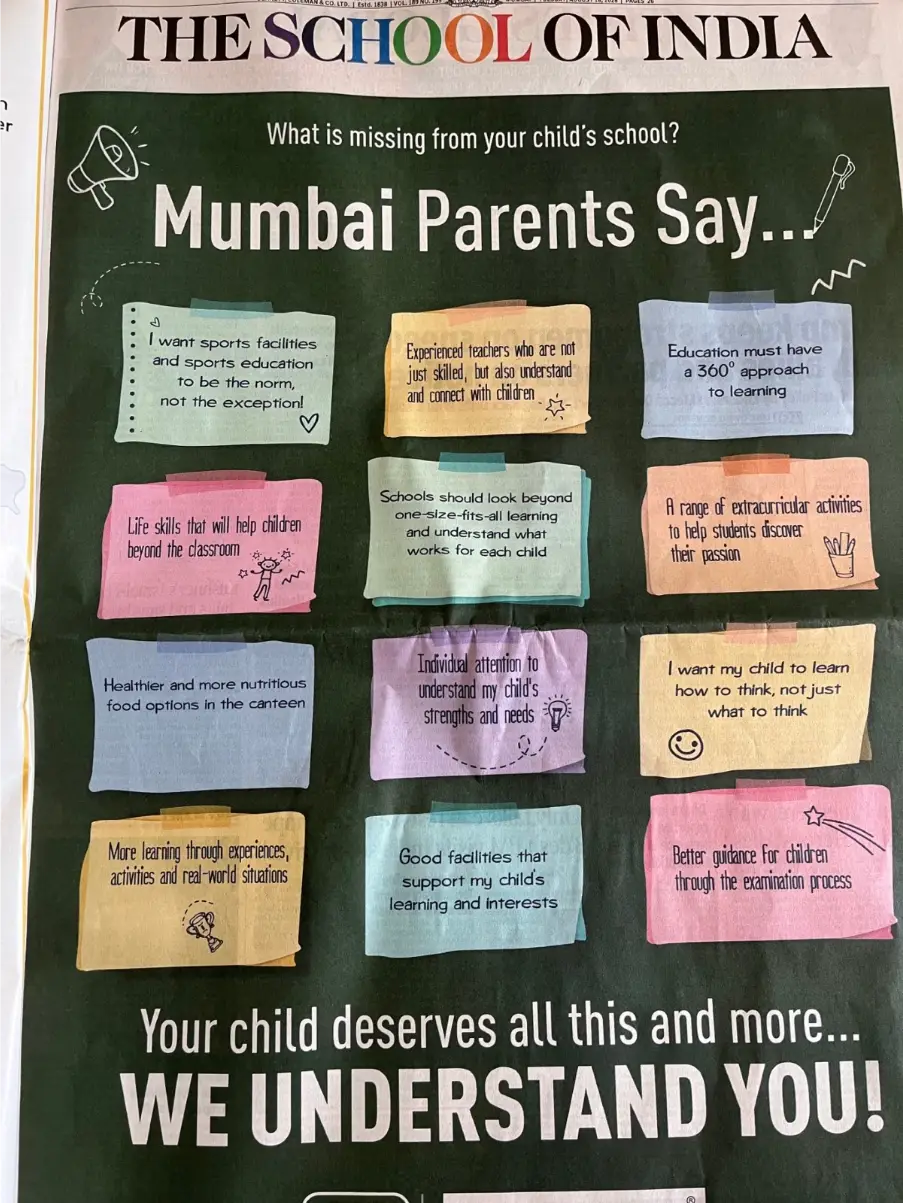
We have spent decades establishing that experiential learning works. Yet knowing it works seems to have changed remarkably little about how most children actually spend their school days.
That is the real story.
The gap between what we know and what we do
The reasons are not difficult to understand.
Board examinations remain a primary gateway to higher education and, ultimately, to opportunity. When an examination carries that kind of weight, the entire ecosystem naturally begins to organise itself around it — schools, teachers, parents and, eventually, students themselves.
There is little room in a tightly packed academic calendar for things that are harder to timetable and even harder to measure.
A meaningful internship takes time.
A community project needs relationships beyond the school gate.
Field-based inquiry requires curiosity, planning and a willingness to follow where the questions lead.
A maker space needs more than equipment; it needs teachers who are comfortable with experimentation, failure and unfinished answers.
And perhaps most importantly, these experiences introduce something schools are often not designed to accommodate: a little uncertainty.
A real-world problem does not always arrive with a marking scheme.
Nor can we simply ask teachers to step into the role of mentor, facilitator and coach of real-world problem-solving without giving them the preparation, tools and institutional support to do so. Changing the role without changing the preparation is unlikely to produce the transformation we hope for.
The result is a familiar contradiction: we increasingly know what meaningful learning looks like, while the structures surrounding learning continue to reward something else.
AAAAA
When quality becomes a privilege
There is another, quieter issue worth confronting.
Experiential learning is still too often presented as a feature of a premium education — something offered by international schools and elite private institutions to distinguish themselves from others.
But why should the opportunity to learn through the real world depend on the school fee a family can afford?
A child does not need a robotics laboratory to investigate a problem. They do not need an international school to work on a community challenge. They do not need an expensive programme to interview a local entrepreneur, investigate their neighbourhood, build something, test an idea or collaborate with someone from another part of the world.
Experiential learning is not a luxury
It is a way of designing learning
The question, therefore, is not whether we should abandon examinations or turn every classroom into an innovation lab overnight. It is whether we can gradually build a system in which examinations and real-world learning are no longer competing priorities.
That might mean:
Broadening what we assess — giving greater value to application, problem-solving, collaboration and reflection alongside knowledge retention.
Investing in teachers as facilitators — through sustained professional development rather than one-off workshops.
Creating affordable bridges to the real world — through local businesses, community organisations, universities, entrepreneurs, cross-school collaborations and international exchanges.
Making experiential learning part of the architecture of education — rather than an enrichment activity available to those who can afford it.
Measuring more of what matters — developing ways to understand whether young people are becoming curious, adaptable, collaborative and capable of applying what they know beyond the classroom.
XXXXX
None of this is particularly radical
In fact, much of it is already happening — in pockets, in individual classrooms, in progressive schools, through passionate teachers and through programmes that have quietly demonstrated what is possible.
Perhaps the challenge is not discovering what works anymore.
Perhaps the challenge is finding the courage — and the structures — to make what works less exceptional.
I kept thinking about that newspaper advertisement.
In a way, it was an unintended contradiction. An institution selling a premium education was telling us what parents already knew: that children need learning that connects with the world beyond the classroom.
The interesting question is what happens when we stop treating that kind of learning as a premium feature — and start asking what it would take to make it ordinary.